.svg)
.svg)
.svg)

How Much Do Dental Implants Cost in Texas? (2026)
What do dental implants cost in Texas in 2026? Real price ranges by type, what drives the cost, and financing options at Salt Creek Dental in Graham.
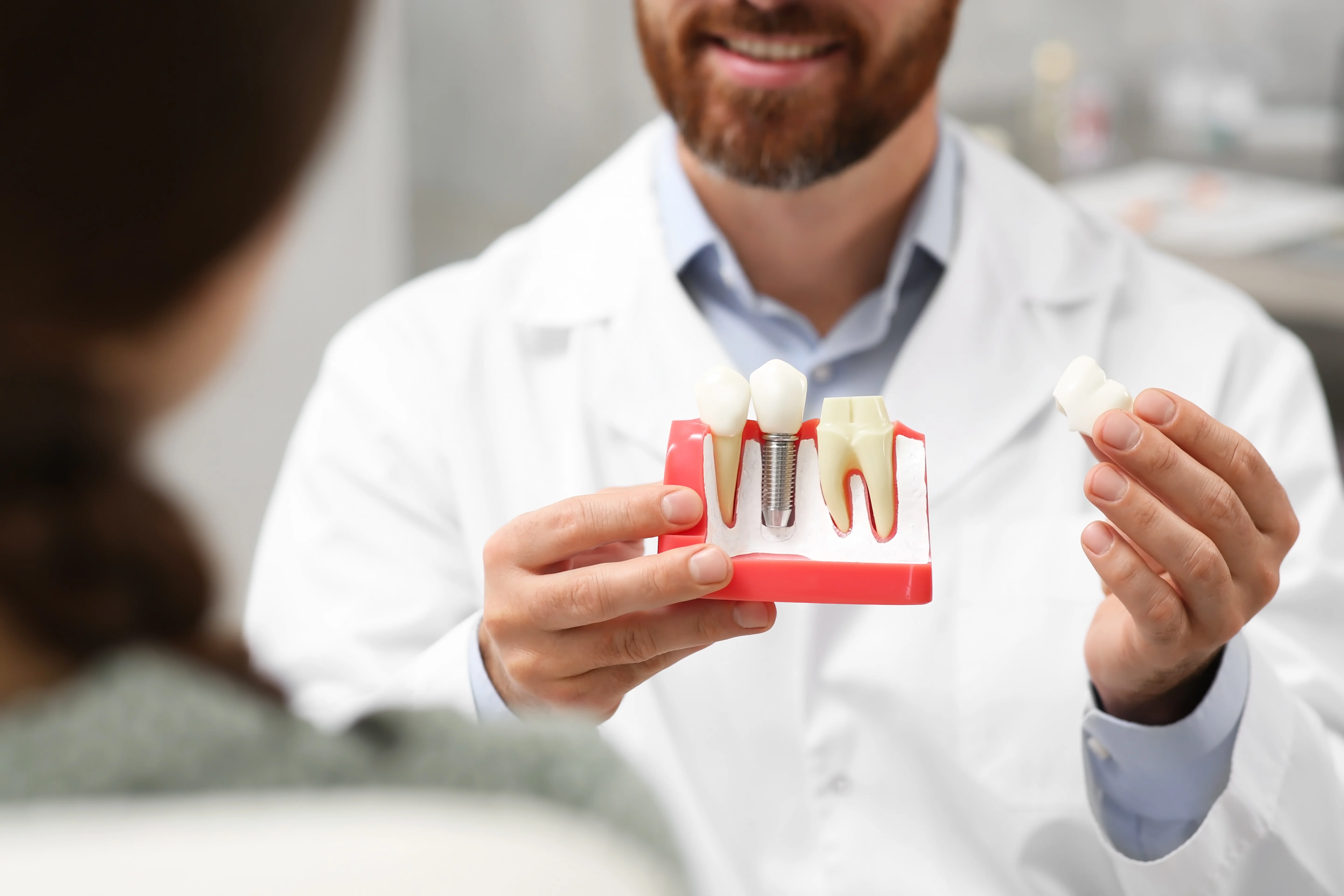
Reviewed by Dr. David Scott, DDS, Salt Creek Dental, Graham, TX.
Here is the short answer, before the explanation.
In Texas in 2026, a single dental implant with its abutment and crown typically runs $3,000 to $6,000 all in. A full arch, using the all on four style approach, typically runs $15,000 to $30,000 per arch. Rural North Texas generally sits at or below state averages, so Graham tends to be more affordable than Dallas or Fort Worth.
Those are wide ranges, and the width is the honest part. What lands you at one end or the other is the condition of the bone, whether anything needs extracting first, what the crown is made of, and how many teeth are involved. This guide breaks all of that down so you can work out roughly where you would fall before you ever sit in a chair.
One more thing worth knowing up front: an implant is usually not one fee. It is a sequence of them, and comparing a quote that bundles everything against one that does not is how people end up confused about pricing.
Dental Implant Cost at a Glance
The figures below are general Texas ranges for 2026, not Salt Creek Dental's fees. Your own number comes from a consultation and a written treatment plan.
| Component or treatment | Typical Texas range (2026) |
|---|---|
| Consultation and 3D imaging | $100 to $400 |
| Implant post, the surgical fixture | $1,500 to $2,500 |
| Abutment, the connector | $300 to $800 |
| Crown, the visible tooth | $1,000 to $2,500 |
| Single implant, all in | $3,000 to $6,000 |
| Implant supported bridge, 3 to 4 teeth | $6,000 to $12,000 |
| Full arch or all on four, per arch | $15,000 to $30,000 |
| Full mouth, both arches | $30,000 to $60,000 |
| Implant retained denture, per arch | $6,000 to $15,000 |
Add ons that may apply:
| Add on procedure | Typical Texas range (2026) |
|---|---|
| Simple extraction | $150 to $400 |
| Surgical extraction | $300 to $650 |
| Bone graft, minor socket preservation | $300 to $1,200 |
| Bone graft, major ridge augmentation | $1,500 to $3,500 |
| Sinus lift | $1,500 to $3,000 |
Read the table as a menu rather than a price list. Most people need some of it, not all of it.
What Drives the Price of an Implant
Six things account for most of the variation.
1. Bone volume. This is the big one. An implant needs enough healthy bone to anchor into. If a tooth has been missing for years, the bone in that spot has usually shrunk, because bone that is not being used gets reabsorbed. Rebuilding it with a bone graft adds cost and adds months of healing time. This is also the single strongest argument for not waiting. An implant placed sooner after tooth loss is frequently a simpler, cheaper procedure than the same implant placed three years later.
2. Whether the tooth is still there. A failing tooth has to come out first, and sometimes the socket needs preserving with a graft at the same time to keep the bone from collapsing.
3. Crown material. Zirconia and layered ceramics cost more than simpler materials and look considerably better, which matters a great deal on a front tooth and much less on a back molar. It is a legitimate place to spend differently depending on position. Our crowns page covers the options.
4. Number and position of implants. More implants cost more, but not proportionally. The per implant cost usually drops as the count rises, which is why full arch solutions are far cheaper per tooth than replacing each tooth individually.
5. Imaging and planning. 3D imaging lets the placement be planned precisely against the actual anatomy, including nerve and sinus position. We use 3D imaging in our office. It is a real cost and it is also the thing that most reduces the chance of an expensive surprise.
6. Sedation. Nitrous oxide or, for adult patients, oral conscious sedation adds to the visit cost. For patients who would otherwise not go through with treatment, it is not really optional.
What does not meaningfully drive the price: the brand of the implant, in most cases. Reputable systems perform comparably. Be more interested in the dentist's planning and experience than the label on the fixture.
Single Tooth vs. Multiple vs. Full Arch
The right solution depends on how many teeth are missing and where.
One missing tooth
A single implant with a crown, typically $3,000 to $6,000.
Worth comparing against a traditional bridge, which usually costs $2,000 to $5,000 and is cheaper up front. The catch is that a bridge requires grinding down the two healthy teeth either side to serve as anchors, and it does nothing to stop the bone loss underneath the gap. Bridges also typically need replacing every 10 to 15 years. An implant leaves the neighbouring teeth untouched and preserves the bone.
Over a 20 or 30 year horizon the implant is usually the cheaper option. Over a 5 year horizon it is not. Which matters more depends on your age, your circumstances, and your budget, and it is a reasonable thing to talk through rather than be sold on.
Several missing teeth in a row
An implant supported bridge, typically $6,000 to $12,000 for three or four teeth. Two implants can support three or four teeth, so you are not paying per tooth. This is usually far better value than individual implants for each gap.
A full arch, or all teeth failing
Two main routes.
Full arch fixed, all on four style, typically $15,000 to $30,000 per arch. Four to six implants support a complete fixed arch of teeth. It does not come out. It functions closest to natural teeth. It is the most expensive option and, for most patients who can manage it, the best one.
Implant retained dentures, typically $6,000 to $15,000 per arch. Two to four implants, with a denture that snaps onto them. It is removable for cleaning, but it does not shift, slip, or need adhesive.
We offer implant retained dentures, and they deserve more attention than they get. If you or a parent are struggling with a lower denture that will not stay put, which is extremely common, because the lower jaw offers very little for a conventional denture to grip, this is often the single highest impact treatment available. Patients routinely describe eating food they had given up on. It costs a fraction of a full fixed arch. If you are weighing the two approaches, our comparison of implants versus dentures goes deeper.
Does Insurance Help? Financing and Payment Options
Does dental insurance cover implants? Increasingly, partially. It used to be a flat no. Many plans now pay something toward implants, often treating them like a major restorative procedure at around 50 percent coverage. The limitation is usually the plan's annual maximum, which commonly sits between $1,000 and $2,000, so even generous coverage may only offset part of a single implant in a given year.
A few useful angles:
- The crown is sometimes covered even when the implant is not. Ask specifically, component by component, rather than asking "do you cover implants."
- Extractions and bone grafts may be covered under different categories than the implant itself.
- Annual maximums reset. For multi stage treatment, timing stages across two benefit years can genuinely capture two annual maximums.
- Medical insurance occasionally contributes where tooth loss resulted from an accident or a medical condition.
At Salt Creek, we are not a PPO provider, but we will gladly bill all insurance plans on your behalf. Being out of network does not mean your plan pays nothing, and we submit the claim for you rather than handing you a form.
If you have no insurance, we offer special discounts for cash paying patients and separate discounts for senior patients. Ask when you call, and see our fuller guide to going to the dentist without insurance.
Other routes worth knowing:
- Third party health financing with interest free promotional periods. Read what happens when the promotion ends.
- HSA and FSA funds are generally eligible, which means you are paying with pre tax money.
- Staging the treatment. Implants already involve waiting months between placement and the final crown while the bone integrates. That natural spacing can often be used to spread payments.
Whatever the route, we will give you the full cost in writing before anything starts. You can see how the treatment itself works, step by step, on our dental implants page.
Are Implants Worth It vs. Cheaper Alternatives?
An honest comparison, including where implants are the wrong answer.
| Option | Up front cost | Lifespan | Preserves bone? |
|---|---|---|---|
| Implant and crown | $3,000 to $6,000 | 20+ years, often permanent | Yes |
| Traditional bridge | $2,000 to $5,000 | 10 to 15 years | No |
| Partial denture | $700 to $2,500 | 5 to 10 years | No |
| Do nothing | $0 | Not applicable | No, accelerates bone loss |
Implants generally make sense if you are in reasonable health, you have or can build adequate bone, you want a permanent solution, you do not want healthy neighbouring teeth altered, and you can manage the cost with or without financing.
A bridge or partial denture may be the better call if the budget genuinely will not stretch, if you need a faster result, since implants take months, or if a medical condition makes surgery inadvisable. A well made bridge is a perfectly respectable treatment, not a consolation prize.
"Do nothing" is the option that deserves the most scrutiny, because it feels free and is not. A gap causes the neighbouring teeth to drift and tilt, the opposing tooth to over erupt, the bite to change, chewing to shift to the other side, and the jawbone in that area to steadily shrink. Two years of doing nothing can turn a straightforward implant into an implant plus a bone graft. The cost of waiting is real, it just arrives later.
Implants also have the highest patient satisfaction of any tooth replacement, and long term success rates above 95 percent when they are well planned and well maintained. "Well maintained" is doing work in that sentence. Implants do not decay, but the gum and bone around them can become infected, so they need the same brushing, flossing, and regular checkups as natural teeth.
Frequently Asked Questions
How much does a dental implant cost in Texas?
A single dental implant in Texas in 2026 typically costs $3,000 to $6,000 in total, which covers the implant post, the abutment, and the crown. Rural areas including Graham and Young County generally sit at or below state averages, so costs tend to be lower than in Dallas or Fort Worth. Additional procedures such as an extraction or a bone graft add to that figure, so a written treatment plan is the only way to know your specific number.
Does insurance cover dental implants?
Many dental plans now provide partial coverage for implants, often around 50 percent as a major restorative procedure, though the plan's annual maximum of roughly $1,000 to $2,000 usually limits how much of it is actually paid in a single year. Ask about each component separately, because the crown, the extraction, and the bone graft are sometimes covered under different categories even when the implant itself is not. Salt Creek Dental is not a PPO provider but will bill all insurance plans on your behalf.
How much is a full set of dental implants?
A full fixed arch using an all on four style approach typically costs $15,000 to $30,000 per arch in Texas, or roughly $30,000 to $60,000 for both. A more affordable alternative is an implant retained denture, typically $6,000 to $15,000 per arch, which uses two to four implants to hold a denture securely in place. The implant retained option is removable for cleaning but does not slip or require adhesive.
Are dental implants worth the cost?
For most patients, yes. Implants last 20 years or more and often permanently, they preserve the jawbone rather than allowing it to shrink, and they do not require altering healthy neighbouring teeth the way a bridge does. Bridges cost less up front but typically need replacing every 10 to 15 years, so the long term math usually favours the implant. Where budget, timeline, or a medical condition rules out surgery, a well made bridge or partial denture remains a good treatment.
Find Out What It Would Cost for You
Every range on this page is a range because the answer genuinely depends on your mouth. The way to replace a range with a number is a consultation and a 3D scan.
You will leave knowing what you need, what the options are, what each one costs in writing, and what your insurance is likely to contribute. No obligation to book treatment.
Salt Creek Dental
901 Austin Rd, Graham, TX 76450
(940) 549-9500
Monday through Thursday, 8AM to 5PM
Serving Graham and the surrounding Young County communities.
Book an implant consultation | Dental implants | Implant retained dentures
Ready for a Beautiful Smile?
Fill out the form and get a callback in 48 hours or less.


Book Your Appointment Now
.svg)

Frequently Asked Questions
Common Dental Questions Answered for Graham, Texas Families
.svg)
.svg)
.svg)

How often should I visit the dentist?
Routine dental visits every six months help maintain good oral health and prevent future issues.
Do you offer discounts for cash clients or seniors?
Yes, we offer special discounts for cash-paying clients and senior patients to make dental care more affordable. Contact our office to learn more about the discounts available for your treatment plan.
Will you bill my insurance if you're not a PPO provider?
Absolutely! While we are not a PPO provider, we will gladly bill all insurance plans on your behalf to help you maximize your benefits. Please reach out to us with your insurance details for assistance.
What should I do if I have a dental emergency?
For any dental emergency, it’s important to contact us as soon as possible so we can provide timely care and relieve discomfort.